AI Breakup Recovery Journal Prompts: 7-Day Healing Plan
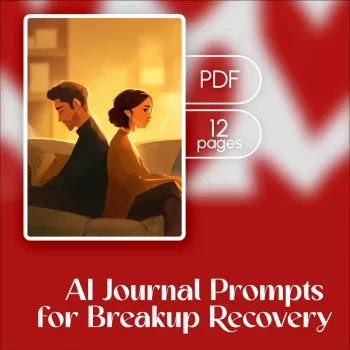
AI Journal Prompts for Breakup Recovery: A Gentle Digital Guide for Healing and Confidence
A breakup can disrupt sleep, appetite, focus, and self-worth. Guided journaling can help organize thoughts, process grief, and rebuild a sense of identity—without forcing “positive vibes” too soon. This digital set of AI-guided journal prompts and exercises supports steady, compassionate reflection, helping emotions move through instead of staying stuck.
What Breakup Recovery Really Looks Like (and Why It Feels So Intense)
Breakup recovery rarely follows a neat timeline. Shock, bargaining, anger, sadness, relief, and mixed feelings can show up in any order—sometimes all in the same day. That emotional “whiplash” doesn’t mean something is wrong with you; it’s a normal response to a meaningful attachment shifting or ending.
Separation can register in the brain like a threat: attachment systems activate, habit loops search for the familiar, and the loss of future plans can feel like losing part of your identity. Grief isn’t limited to death; it also appears after major losses and transitions, including relationship endings. For a deeper overview of grief responses, see the American Psychological Association’s overview of grief and Mayo Clinic’s summary of grief symptoms and causes.
Common coping traps can intensify pain, even when they’re understandable:
- Rumination and replaying conversations to find the “one” missing explanation
- Checking socials, re-reading texts, or searching for signs you were replaced
- Idealizing the past while minimizing the parts that hurt
- Self-blame that turns a complex relationship into a single “fault”
- Rebound choices made mainly to numb or prove worth
A gentler goal is to reduce emotional spikes, regain clarity, and rebuild self-trust—one small decision at a time.
How Guided Journaling Supports Emotional Healing
Journaling works best when it becomes a safe container, not a performance. When the feelings are hard to say out loud, writing gives them a place to land. It also helps you name emotions precisely—hurt, rejection, loneliness, guilt, jealousy—instead of defaulting to “fine” or “a mess.”
Guided exercises can create insight by separating facts, interpretations, and assumptions. That shift matters because a fact (“they ended the relationship”) can be true while an assumption (“I’m unlovable”) is a painful story, not a verdict. Over time, structured writing can also strengthen self-compassion and boundaries by clarifying needs and values.
Finally, journaling can support stability through small, repeatable actions—sleep, food, movement, and connection—so your nervous system gets more chances to settle.
What’s Inside the Digital Breakup Recovery Journal Prompt Set
The AI Journal Prompts for Breakup Recovery digital download is a structured collection of AI-guided writing invitations designed for different stages of recovery. It includes short exercises for days when energy is low, plus deeper reflections for when focus returns.
Inside, you’ll find confidence-building reflections to reconnect with your identity outside the relationship, along with a download-and-use format for private journaling at home or on the go. It can also work well alongside therapy or coaching as between-session support (not a replacement for professional care).
At-a-Glance: How Each Exercise Type Helps
| Exercise type | When to use it | What it supports |
|---|---|---|
| Emotional release pages | When feelings spike or sleep is disrupted | Reduces intensity by giving emotions a place to land |
| Reality-check reflections | When the mind loops on “what if” scenarios | Separates facts from stories; reduces rumination |
| Boundary and closure writing | When contact urges arise | Clarifies needs, non-negotiables, and next steps |
| Identity rebuild prompts | When confidence feels low | Reconnects with strengths, values, and goals |
| Self-care planning | When daily functioning is hard | Turns care into doable routines and micro-habits |
A 7-Day Gentle Journaling Plan (Flexible and Repeatable)
This plan is designed to be repeated as needed. If you miss a day, return to the one that fits your current emotional weather.
- Day 1: Stabilize — Write a “right now” page: what hurts, what is needed today.
- Day 2: Name the loss — List what ended (daily habits, future plans, sense of safety) and validate grief.
- Day 3: Reality and meaning — Note facts vs. interpretations; identify one belief that needs softening.
- Day 4: Reclaim boundaries — Draft a clear boundary statement (contact, socials, mutual spaces).
- Day 5: Self-trust — Write evidence of past resilience and decisions made from strength.
- Day 6: Identity outside the relationship — Interests, friendships, goals, values, and routines to revive.
- Day 7: Future vision — A compassionate plan for the next two weeks (support, self-care, milestones).
How to Use the Prompts on Hard Days (When Motivation Is Gone)
Hard days aren’t a failure—they’re part of recovery. When motivation disappears, lower the bar until it’s reachable:
Confidence After a Breakup: Rebuilding Without Rushing
Extra Digital Tools You May Like
- AI Journal Prompts for Breakup Recovery | Healing Guide, Journaling Exercises, Digital Download for Self-Care, Emotional Healing & Confidence
- Understanding Why Kids Hit and How to Guide Them – A Gentle Parenting Guide Exploring kids hitting others reasons
- 3 Smart & Simple Ways Millennials Can Start Investing Today | MRR Guide | Financial Freedom eBook | Passive Income for Beginners | 3 Ways Millennials Can Invest PDF
When Extra Support Matters
FAQ
How soon after a breakup should journaling start?
It can start immediately with short, grounding check-ins. On day one, a few lines about what hurts and what you need today is often more helpful than pushing for deep meaning.
What if journaling makes the feelings feel stronger?
That can happen, especially early on. Use time limits, switch to structured prompts, and add grounding (breathing, a walk, a warm drink); if the intensity feels unmanageable, pause and reach out for support.
Can this be used alongside therapy?
Yes—guided writing can be a practical between-session tool for organizing thoughts and tracking patterns. It supports therapy, but it doesn’t replace professional care.
















Leave a comment